The Sebaceous Gland: The Hidden Control Centre Behind Hormonal Acne
The Sebaceous Gland: The Hidden Control Centre Behind Hormonal Acne
For decades, hormonal acne has been explained as a problem of excess testosterone and increased oil production. While hormones certainly play a role, modern dermatology has revealed something much more sophisticated. The sebaceous gland isn't simply an oil-producing gland; it is a highly active neuro-immuno-endocrine organ that communicates with your hormones, immune system, nervous system, microbiome and even your metabolism.

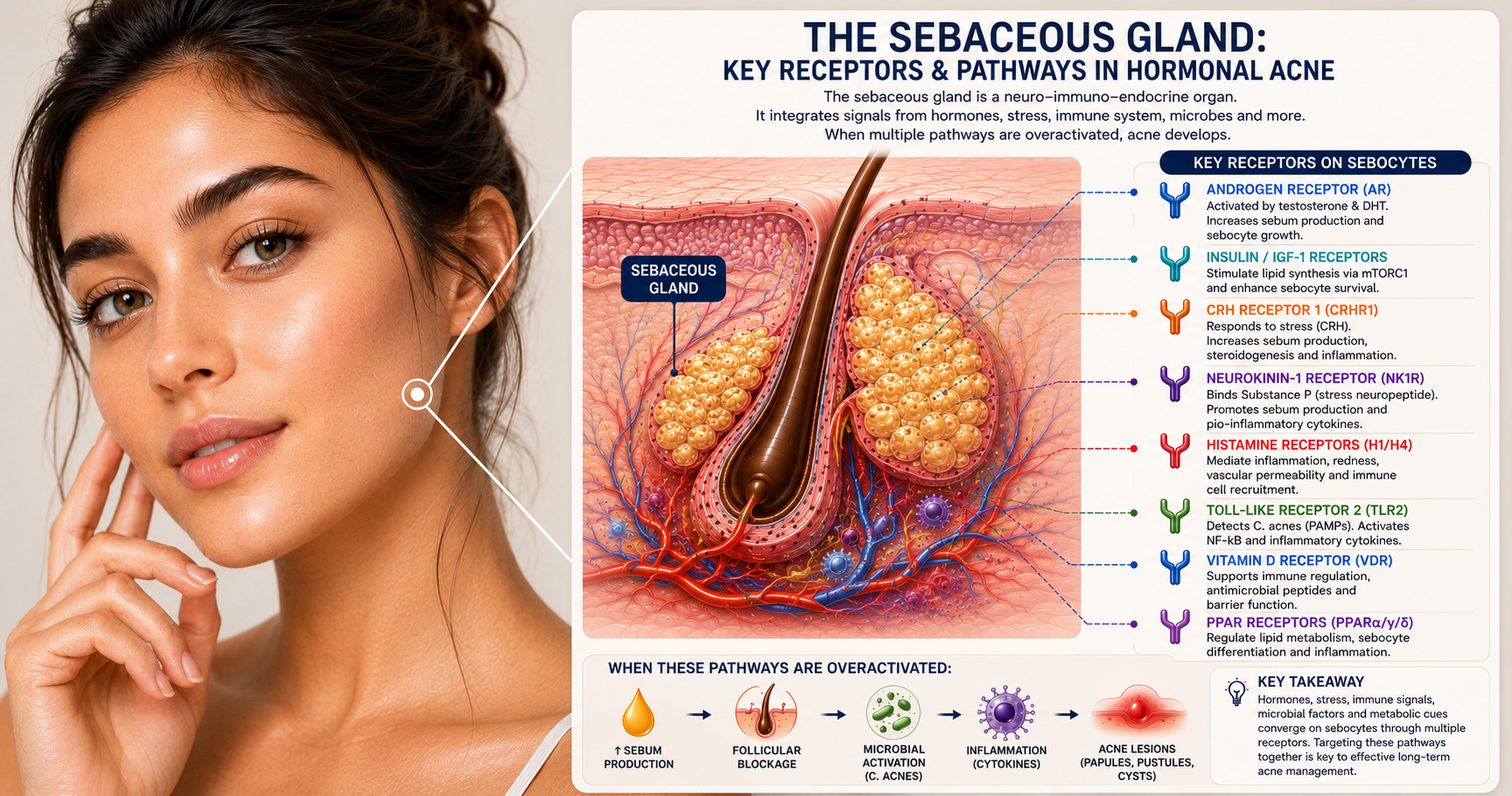
The diagram above illustrates the major receptors found on sebaceous glands and shows how multiple biological pathways converge to influence acne development. Understanding these pathways helps explain why acne can flare during periods of stress, hormonal changes, poor diet, inflammation or illness and why treating only one pathway often produces disappointing results.
What is the sebaceous gland?
Sebaceous glands are microscopic glands attached to hair follicles. Their primary role is to produce sebum, a complex mixture of lipids that lubricates the skin, strengthens the barrier and helps protect against pathogens. However, research now shows sebocytes (the cells that make up the sebaceous gland) also produce hormones, cytokines, antimicrobial peptides and inflammatory mediators. Rather than acting like a simple oil factory, the sebaceous gland behaves like a miniature endocrine organ capable of responding to dozens of chemical signals throughout the body.
The Androgen Receptor (AR): The Master Controller of Sebum Production
The androgen receptor is the best-known receptor involved in acne. When testosterone or dihydrotestosterone (DHT) binds to this receptor, sebocytes begin producing more lipids and the gland enlarges. Interestingly, many women with hormonal acne have completely normal hormone levels. Instead, their sebaceous glands are more sensitive to androgens, meaning the receptors respond more strongly than expected. This explains why blood tests can appear normal while acne remains severe.
The Insulin and IGF-1 Receptors
The sebaceous gland also contains receptors for insulin and insulin-like growth factor-1 (IGF-1). When activated, these receptors stimulate the mTORC1 signalling pathway, a major regulator of cell growth and lipid synthesis. High glycaemic diets and insulin resistance increase circulating insulin and IGF-1, amplifying androgen signalling and increasing sebum production. This is one reason diets rich in refined carbohydrates may worsen acne in susceptible individuals.
The Stress Pathway: CRHR1
One of the most fascinating discoveries is that sebaceous glands possess receptors for corticotropin-releasing hormone (CRH). CRH is released during stress and activates the CRHR1 receptor on sebocytes.
Activation of this pathway increases:
-
Sebum production
-
Local steroid hormone synthesis
-
Inflammatory cytokines
-
Sebocyte proliferation
This means your skin can respond directly to psychological stress, even before systemic hormone levels change.
Substance P: The Missing Link Between Stress and Acne
Substance P is a neuropeptide released from sensory nerves during stress, pain and inflammation.
Sebaceous glands express Neurokinin-1 receptors (NK1R), which bind Substance P.
When activated, Substance P:
-
Increases sebaceous gland growth
-
Stimulates sebum production
-
Activates inflammatory cytokines including IL-1β, IL-6 and TNF-α
-
Triggers mast cell activation
-
Delays wound healing
This helps explain why stress often leads to painful inflammatory cysts rather than simply increasing oiliness.
Histamine Receptors: Why Some Acne is So Inflamed
Histamine is commonly associated with allergies, but it also plays an important role in inflammatory skin disease. Sebocytes express histamine receptors, particularly H1 and H4 receptors.
Histamine contributes to:
-
Vasodilation
-
Redness
-
Swelling
-
Immune cell recruitment
-
Amplification of inflammatory signalling
Histamine does not generally initiate acne but can significantly worsen inflammatory lesions.
The Skin's Immune Sensors: TLR2
Your sebaceous gland constantly monitors bacteria living on the skin. One of its most important receptors is Toll-like receptor 2 (TLR2).
TLR2 recognises components of Cutibacterium acnes (formerly Propionibacterium acnes).
Once activated, TLR2 stimulates NF-κB signalling and triggers production of inflammatory cytokines including:
-
IL-1β
-
IL-6
-
IL-8
-
TNF-α
These cytokines recruit immune cells into the follicle, transforming a blocked pore into an inflamed papule, pustule or cyst.
Vitamin D Receptors
Sebocytes also express vitamin D receptors (VDR).
Vitamin D influences:
-
Immune regulation
-
Keratinocyte differentiation
-
Antimicrobial peptide production
-
Barrier repair
Deficiency may alter immune responses and barrier function, although vitamin D supplementation has not been shown to benefit everyone with acne.
PPAR Receptors
Peroxisome proliferator-activated receptors (PPARα, PPARγ and PPARδ) regulate sebocyte differentiation and lipid metabolism.
These receptors help determine:
-
Which lipids are produced
-
How sebocytes mature
-
How inflammation is regulated
PPAR signalling is increasingly recognised as an important regulator of sebaceous gland biology.
Retinoid Receptors
Retinoids bind nuclear receptors known as RAR and RXR.
These receptors normalise keratinocyte differentiation, reduce follicular plugging and suppress sebocyte proliferation.
This explains why retinoids remain one of the most effective treatments for acne.
Cannabinoid Receptors
Sebaceous glands express CB1 and CB2 cannabinoid receptors.
These receptors help regulate inflammation and lipid synthesis, although their effects depend on which cannabinoid is activating the receptor.
This remains an exciting area of ongoing research.
The Aryl Hydrocarbon Receptor (AhR)
The AhR receptor detects environmental compounds such as pollution, cigarette smoke and certain dietary molecules.
Activation influences:
-
Sebocyte differentiation
-
Oxidative stress
-
Inflammatory signalling
Emerging evidence suggests environmental exposures may alter acne severity through this pathway.
Acne is a Network Disease
Perhaps the most important lesson from this diagram is that acne is not driven by a single cause. Instead, it develops through continuous communication between multiple biological systems.
Hormones stimulate androgen receptors.
Stress activates CRHR1 and NK1R.
Histamine amplifies inflammation.
Bacteria activate TLR2.
Insulin activates IGF-1 receptors.
Environmental signals influence AhR.
Together these pathways determine whether a pore remains healthy or progresses to inflammation and acne.
The Neuro-Immuno-Endocrine Model of Acne
Modern research increasingly describes acne as a disorder of the neuro-immuno-endocrine axis. This means the nervous system, immune system, endocrine system and skin communicate constantly through shared chemical messengers.
Rather than asking, "What causes hormonal acne?" a better question may be:
Which signalling pathways are driving this person's acne?
Understanding these pathways opens the door to more targeted, personalised treatment strategies that go beyond simply reducing oil production and instead address the complex biology of the sebaceous gland itself.
The future of acne treatment lies not in targeting one hormone or one bacterium, but in understanding the sophisticated communication network occurring within one of the skin's most remarkable organs.
Author
Jacine Greenwood is a globally recognised cosmetic chemist, educator, and founder of Roccoco Botanicals. Known in the industry as “The Fairy Godmother of Skin,” she is renowned for her science-first approach to acne, rosacea, barrier repair, and microbiome health. Jacine is passionate about translating complex skin science into practical, results-driven education that helps both practitioners and consumers achieve lasting skin transformation
Through Roccoco Botanicals, Jacine has trained skin professionals globally and developed award-winning formulations used in clinics across Australia, the USA, Canada, and New Zealand. Her writing focuses on translating complex skin science into practical, evidence-based education that empowers both practitioners and consumers to make informed decisions about skin health.
References
- Zouboulis CC, et al. (2022). The Skin as an Endocrine Organ: Sebocytes, Sebaceous Glands, and Acne. Dermato-Endocrinology.
- Zouboulis CC. (2004). Acne and Sebaceous Gland Function. Clinics in Dermatology, 22(5), 360–366.
- Zouboulis CC, et al. (2014). Sebaceous Gland: A Neuro-Immuno-Endocrine Organ. Dermato-Endocrinology, 6(1): e983951.
- Thiboutot D. (2004). Regulation of Human Sebaceous Glands. Journal of Investigative Dermatology, 123(1), 1–12.
- Chen W, Zouboulis CC. (2009). Hormones and the Pilosebaceous Unit. Dermato-Endocrinology, 1(2), 81–86.
- Melnik BC. (2015). Linking Diet to Acne Metabolomics, Inflammation and Comedogenesis. Clinical Cosmetic and Investigational Dermatology, 8, 371–388.
- Melnik BC. (2018). Acne Vulgaris: The Metabolic Syndrome of the Pilosebaceous Follicle. Clinical Dermatology.
- Melnik BC. (2012). Evidence for Acne-Promoting Effects of Milk and Other Insulinotropic Dairy Products. Nestlé Nutrition Workshop Series.
- Smith RN, et al. (2007). A Low Glycemic Load Diet Improves Symptoms in Acne Vulgaris. American Journal of Clinical Nutrition, 86, 107–115.
- Zouboulis CC, Böhm M. (2004). Neuroendocrine Regulation of Sebocytes. Dermato-Endocrinology.
- Toyoda M, Morohashi M. (2001). Pathogenesis of Acne. Medical Electron Microscopy, 34, 29–40.
- Toyoda M, et al. (2002). Expression of Neurokinin-1 Receptors in Human Sebaceous Glands and Their Stimulation by Substance P. Journal of Investigative Dermatology, 119, 1126–1132.
- Arck PC, et al. (2006). Neuroimmunology of Stress: Skin Takes Centre Stage. Journal of Investigative Dermatology, 126, 1697–1704.
- Theoharides TC, et al. (2012). Mast Cells and Inflammation. Biochimica et Biophysica Acta, 1822, 21–33.
- Kritas SK, et al. (2014). Mast Cells Contribute to Skin Inflammation. Clinical Therapeutics, 36, 101–112.
- Guhl S, Babina M. (2017). Neuro-Immune Interactions in the Skin. Experimental Dermatology, 26, 980–986.
- Kim J. (2005). Review of the Innate Immune Response in Acne Vulgaris: Activation of Toll-Like Receptor 2 by Cutibacterium acnes. Journal of Investigative Dermatology, 125, 1085–1091.
- Jugeau S, et al. (2005). Induction of Toll-Like Receptors by Propionibacterium acnes. British Journal of Dermatology, 153, 1105–1113.
- Dreno B, et al. (2018). Cutibacterium acnes (Propionibacterium acnes) and Acne Vulgaris. Journal of the European Academy of Dermatology and Venereology, 32(Suppl 2), 5–14.
- Trivedi NR, et al. (2006). Peroxisome Proliferator-Activated Receptors Increase Sebaceous Lipogenesis. Journal of Investigative Dermatology, 126, 2002–2009.
- Lim SK, et al. (2016). Comparison of Vitamin D Levels in Patients with and without Acne. PLoS One, 11.
- Agak GW, et al. (2014). Vitamin D Suppresses Cutibacterium acnes-Induced Th17 Responses. Journal of Investigative Dermatology, 134, 2288–2297.
- Fisher GJ, et al. (1996). Mechanisms of Retinoid Action. Journal of the American Academy of Dermatology, 34(Suppl), S22–S27.
- Kang S, et al. (1995). Topical Retinoids in the Treatment of Acne. Journal of the American Academy of Dermatology.
- Dobrosi N, et al. (2008). Endocannabinoids Enhance Lipid Synthesis in Human Sebocytes via CB2 Receptors. Journal of Clinical Investigation, 118, 3313–3325.
- Oláh A, et al. (2014). Cannabidiol Exerts Sebostatic and Anti-Inflammatory Effects on Human Sebocytes. Journal of Clinical Investigation, 124, 3713–3724.
- Furue M, et al. (2014). Aryl Hydrocarbon Receptor in Skin Homeostasis and Inflammatory Disease. Journal of Dermatological Science, 74, 151–159.
- Tsuji G, et al. (2022). Environmental Pollutants, AhR Signalling and Skin Disease. International Journal of Molecular Sciences, 23, 1115.
- Slominski A, et al. (2013). The Skin as an Endocrine Organ. Physiological Reviews, 93, 1027–1088.
- Paus R, et al. (2006). The Neuroendocrine Skin. Endocrine Reviews, 27, 505–539.
- Zouboulis CC. (2019). The Human Sebaceous Gland in Health and Disease. Experimental Dermatology, 28, 873–882.